
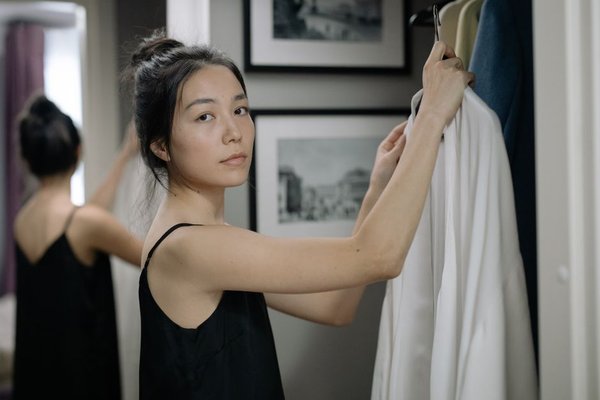
Being tall gives clothes plenty of space to make an impression, but getting an outfit to feel balanced can be surprisingly fiddly. A jumper might finish just above the waistband, a jacket can look shorter than intended, or a single colour from shoulder to shoe can create more length than you wanted. The answer is not to disguise your height. Learning how to dress a tall frame is about deciding where the eye pauses and how each garment relates to the next.
Start with your proportions, not your height
Two people of the same height may need completely different styling adjustments. One might have a longer torso and comparatively shorter legs; another might have long legs and a shorter waist-to-shoulder measurement. Tall proportions are not one body shape.
Stand in front of a full-length mirror wearing a simple top and trousers. Notice where your natural waist sits, where the top ends, and whether your outfit seems weighted towards the upper or lower half. The aim is not to divide your body into perfect fractions. It is to spot which lines you want to emphasise and which could use a visual break.
For example, someone with long legs might prefer a longer untucked shirt or a jacket ending below the hip. Someone with a long torso may enjoy a tucked top and trousers that sit nearer the natural waist. Both approaches celebrate height while changing the outfit’s overall balance.
Match clothing scale to the space it occupies
On a tall frame, tiny details can sometimes look lost, especially when the rest of an outfit is generously cut. Consider the scale of lapels, collars, pockets, belts and patterns alongside the garment itself. A substantial collar may sit comfortably on a long coat, while very narrow detailing can produce a more delicate effect.
Scale does not mean wearing everything oversized. If your trousers are wide, a closer-fitting knit can provide contrast. If you favour a roomy shirt, try a more defined trouser shape or show the waistband with a partial tuck. A loose top and loose bottoms can work beautifully, but they need an intentional point of structure, such as a clear shoulder line or a visible cuff.
Use hem placement to control visual balance
Where clothes stop is often more influential than their labelled size. A hem creates a horizontal line, directing attention to that part of the body. On a tall frame, those lines can help break up a long silhouette or make it feel uninterrupted.
Tops and jackets
A top ending at the natural waist highlights the separation between torso and legs. A shirt ending around the upper hip softens that division, while a longer overshirt creates an extra layer across the body. Try each length with the same trousers before deciding that one cut is wrong for you.
Jackets deserve particular attention. A short jacket can make the legs appear longer; a hip-length blazer offers a more even division; a longer coat can create a striking continuous line. Check that a cropped jacket is deliberately cropped rather than simply too short in the sleeves or body.
Trousers and skirts
Trouser hem placement can change the entire finish. A full-length wide leg that falls cleanly over the shoe feels different from an ankle-length straight leg that deliberately shows some space. Both can suit taller frames, provided the ending looks intentional. Avoid mistaking an accidentally short inseam for a planned cropped fit.
With skirts, notice where the hem crosses the leg rather than assuming a particular length is universally flattering. Midi lengths can vary considerably depending on your leg length. Try the skirt with the shoes you actually plan to wear, then look at the outfit from several steps back.
Build layers that introduce useful breaks
Layering is an easy way to organise long vertical lines. An open overshirt over a fitted top creates two parallel edges, while a belt or tucked layer adds a horizontal pause. A scarf, contrasting collar or visible shirt cuff can do similar work on a smaller scale.
For a simple daytime example, imagine straight-leg trousers, a plain top and an open blazer. If the whole outfit feels like one tall column, change just one element: tuck the top, choose a blazer that ends nearer the hip, or add a belt with gentle contrast. Reassess before changing anything else. That way you learn which detail actually improves the proportions.
Let colour and texture set the rhythm
Dressing head to toe in one colour encourages the eye to travel smoothly from top to bottom. That can look elegant and powerful, so there is no reason to avoid it. If you want more separation, introduce a different shade at the waist, layer a contrasting jacket, or pair matte fabric with something softly textured.
A five-minute proportion check before you go out
Try the outfit with the shoes and outerwear you will actually use. Stand a few steps away from the mirror and ask where your eye lands first. Then check whether the shoulder line, waist and main hems look purposeful. Finally, move around and sit down; an outfit that only works while standing still is not truly well balanced.
Change one feature at a time. You might adjust a tuck, roll a sleeve or switch between a cropped and longer layer. These tests are more informative than buying something new every time an outfit feels slightly off. For more context, exploring understanding body proportions, choosing jacket lengths and styling wide-leg trousers can help explain why the same garment behaves differently across outfits.
Frequently asked questions
Should tall people avoid vertical stripes?
No. Vertical stripes can reinforce a long visual line, but that may be exactly the effect you want. If you prefer more variety, pair striped clothing with a contrasting layer or a clearly defined waist.
What is the best jacket length for a tall frame?
There is no single best length. A cropped jacket emphasises leg length, a hip-length style creates a visual midpoint, and a longer coat offers a streamlined silhouette. Compare the hem with the waistband and trouser shape.
How can I tell whether trousers are cropped or just too short?
Look at the intended cut, fabric drape and where the hem falls with shoes on. A purposeful cropped style typically has a clean finish and enough room to move; trousers intended to be full length should not look as though the hem has accidentally crept upwards.
Do tall frames need oversized clothes?
Not at all. Oversized pieces are a style choice, not a requirement. A balanced outfit can combine relaxed and tailored items, or use fitted pieces throughout. Correct sleeve, rise and body lengths matter more than adding volume.
Wear your height on your own terms
The most useful principle is to treat proportion as a set of choices rather than a problem to fix. Clothing scale gives details room to register, hem placement controls where an outfit pauses, and thoughtful layers add structure. Once you recognise those effects, you can make a tall silhouette look relaxed, dramatic, minimal or playful without trying to make yourself appear shorter.